


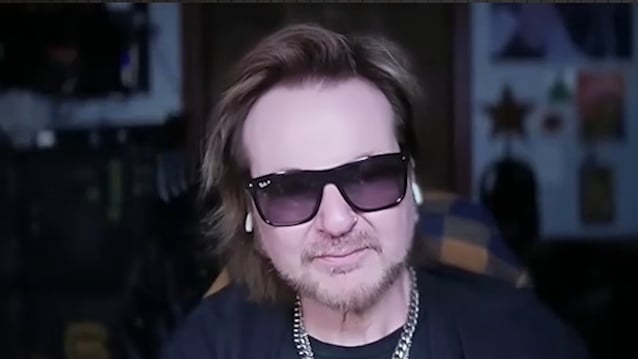
RIKKI ROCKETT Is 'Very, Very Proud' Of POISON's 'Native Tongue' Album: 'I Think It's A Great Record'
August 9, 2026In a new interview with Meltdown of Detroit's WRIF radio station, POISON drummer Rikki Rockett reflected on the band's fourth album, "Native Tongue", which was originally released in 1993. Besides the core personnel of Rockett, singer Bret Michaels and bassist Bobby Dall, it is the only POISON LP to feature Richie Kotzen on lead guitar following the departure of C.C. DeVille in late 1991. "Native Tongue" marked a change for POISON as the band abandoned its anthemic party tunes to focus on more serious subjects, and the LP was far more blues-rock oriented than glam metal. The Richie Zito-produced set featured the singles "Stand" and "Until You Suffer Some (Fire And Ice)" and debuted at No. 16 on the Billboard 200, but it was a commercial disappointment compared to the multiplatinum success of the group's three albums with DeVille, with whom the band would eventually reunite in 1999.
Rikki said (as transcribed by BLABBERMOUTH.NET): "The thing is that during the early part of the whole grunge thing, we were so consumed with trying to kind of reinvent POISON and fill C.C.'s shoes in some way, shape or form, and we realized we're not gonna be able to do that, so we made a little bit of a left turn. And it's funny 'cause I just listened to that record, 'Native Tongue', yesterday. And I haven't listened to it for a while, except for one song that I do in my drum clinic. But I love the way I played on that record. I think it's a great record. Richie was great to work with, and I'm very, very proud of that record. I feel like we went, 'We're not gonna try to be grunge 'cause that's not our jam. We're not gonna try to be what we were with C.C. We're going to turn the page and do a new chapter, and we're gonna do it really well.' And I think we did all those things. Was it as successful as [1988's] 'Open Up And Say... Ahh!', and stuff like that? No, it wasn't. People had grown to understand POISON a certain way, and then there were other types of music that were, obviously out there. And so there was a lot of ingredients for why [it wasn't as successful]. But it still quietly sold a million records in the first few months. And we were still on MTV, and we did get treated differently than some of the other acts that followed us. And it was well-received by a lot of people. A lot of critics liked it. To this day, I think a lot of people like that record. And, again, I do too. I'm sitting there listening, I go, 'I really like what I played on that. That's cool.' I go back to [1986's] 'Look What The Cat Dragged In', and I go, 'Oh my God, why did I play that?' But it's 40 years later. What do you want?"
Speculating about the reasons "Native Tongue" turned out to be a relative commercial disappointment, Rikki added: "Sometimes it's just perception and timing and all that kind of stuff. But we had a great producer. Richie Zito was fantastic to work with. And I think everybody was playing, and Bret was singing — we were at our prime, I feel like. And [we made a] great video. The 'Stand' video's incredible. I look back at that and I go, 'Wow.' We shot it on film. It looked fricking like a movie. It was so good. But it just didn't resonate with core POISON fans — most of them anyway. We went out, we did a tour, we did fine and all that stuff. We did Europe. Again, it was fine. It was good. But it wasn't phenomenal."
A year and a half ago, Kotzen reflected on his brief stint in POISON during an interview following SMITH/KOTZEN's March 2025 acoustic performance at the Grammy Museum in Los Angeles. Richie said: "It's something I'm quite proud of, and I have fond memories of the process of making that record that are very vivid still in my mind, I was very young. I came to L.A. – I was moved here. I was going to San Francisco back and forth from Philadelphia, making albums because [Shrapnel Records] was up there. Then Interscope bought my contract when I was, like, 19 or 20. They moved me to L.A., so for a year, I was working with [future chairman/CEO of Interscope Geffen A&M] Jimmy Iovine and [future chairman/CEO of Warner Bros. Records] Tom Whalley. Then we had Danny Kortchmar ready to produce my album, which was a big thing for me, because he had just done the Don Henley album 'The End Of The Innocence', and I was super-excited. At the last minute, Interscope pulled the plug and said, 'We didn't sign you to be a balladeer.' I flipped out — I was barely 21 at that point — and said, 'You don't know what you're doing with me. Let me out of the contract.'
"As they were letting me out of the contract," he continued, "it was Tom Whalley that said, 'Listen, Bret Michaels has been calling about you. He saw you on the cover of Guitar World, and he wants to meet you.' I flipped out even more — I said, 'Are you out of your fucking mind? I don't want to make a hard rock record. I want to do this other thing. I wrote all these songs.' He said, 'Just go talk to him. I don't think you're ready to make the record that you think you're ready to make.'
'So I go out – I drove out to Calabasas, and Bret had this killer house out on Stunt Road. The minute I met him, I really liked him, because he's from Pennsylvania too. I'm like, 'I feel like I'm at home.' We really connected, but then he kind of got me with, 'Look, I don't want someone to come in here and just do what they're told. I want someone to write an album with.' He wanted a writing partner. The other guys had input as well, but it was primarily he and I [who] really wrote together, to my recollection. I brought in a few songs that would have been on my solo record. 'Stand' was one of them. He added some flavor to it, and we worked on the verse lyrics together and added a bridge. It was really great. I think we really made a great record, and it came out of the gate [strong]. It shipped gold, and unfortunately, by the time we got to release the second single, whatever was happening at MTV, the gatekeepers just closed the gates and said, 'Any band that was famous from a certain era is no longer welcome.' We were subjected to that unfortunately, but outside of that, I love the record. I'm very proud of it."
As for how he approached DeVille's solos in concert, Kotzen acknowledged taking liberties. "I didn't really play them properly," he said. "I did the best I could — I really did — but I wanted to play them in a way where I maintained the integrity of what was written, but I also am me, so I can't help it. I'm going to play it the way I hear it."
Back in 2015, Kotzen played down the story about him dating Rockett's ex-fiancée, which many believe got him ousted from POISON, saying that he has long since made up with his former bandmates. "I saw Bret since then," he explained at the time. "He hugged me and said he loved me and congratulated me on how well I'm doing. I've seen Bobby multiple times. I saw Rikki once and shook his hand and said hello. Everything is completely fine. Whatever happened back then, I will tell you the truth of the matter is that it was really sensationalized; it wasn't nearly as insane as what was put in the press. They needed a story, 'cause the tour was bombing and the band was going into oblivion, so to speak. So, you know, they needed a story… But, in the end, we're all on good terms."
After leaving POISON, Kotzen resumed his solo career and has released records at a prolific rate over the past three decades. Additionally, he recorded two albums with MR. BIG (1999's "Get Over It" and 2001's "Actual Size") and three with THE WINERY DOGS, a power trio that saw him play alongside his former MR. BIG bandmate Billy Sheehan and drummer Mike Portnoy (DREAM THEATER). In 2021, he joined forces with IRON MAIDEN guitarist Adrian Smith in SMITH/KOTZEN; the group's second full-length, "Black Light/White Noise", was released in April 2025 via BMG.


 Prev
Prev 